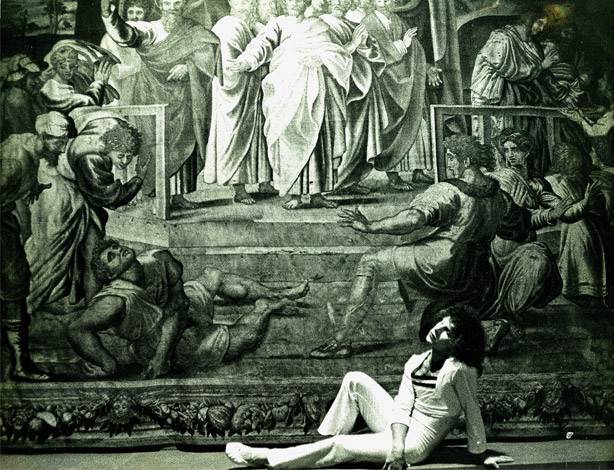
Steven Colucci is a perfectionist. As a painter, he describes himself as “a dictator, a controlling ballet master with a stick,” dispassionately choreographing his composition to achieve the exact result he desires. The paintings of the “Sea Series,” largely completed in 2010, are actually the culmination of 4-5 years of practice for the artist, during which he consistently developed and refined the language and formal elements that visually distinguish the series, sometimes repeating the same image for months until he was satisfied.
Colucci is a perfectionist
Steven Colucci is a perfectionist. As a painter, he describes himself as “a dictator, a controlling ballet master with a stick,” dispassionately choreographing his composition to achieve the exact result he desires. The paintings of the “Sea Series,” largely completed in 2010, are actually the culmination of 4-5 years of practice for the artist, during which he consistently developed and refined the language and formal elements that visually distinguish the series, sometimes repeating the same image for months until he was satisfied.
Title of a Painting Conjures
If the word “sea” in the title of a painting conjures for you images of little easels and landscape canvases featuring sandy beaches, waves, and vast horizons, think again – Colucci’s oceanic visions are experiential, viewing them you are often looking down at the sea, within it, or even dreaming of the ocean. Water, deep or shallow, still or fast-moving, rules how we see light and subjects, as the artist works to reflect what he calls “the spirit, the soul of the water.” In “Deep Blue,” he conjures this anima via a window through levels of roiling currents of rich dark waves and dancing highlights, inviting the viewer to experience the sea as a vibrant and enveloping sensual entity.
Deflecting Credit
Deflecting credit for the power of his paintings by representing himself as a vehicle for inspiration from the divine and nature, Colucci describes painting amidst the elements in his movable outdoor studio as an immersion, 12 hour sessions sustained regardless of the weather. With the beach as his workplace, he rises early and begins his day when the contractors arrive to work on local vacation properties. The frequent deliveries of new fixtures mean discarded packaging, providing Colucci with one of his favorite re-purposed materials.
Sheet Of Cardboard
“A sheet of cardboard can transport the spirit and breathe life into a work of art,” he writes in an artist’s statement. “Corrugated, smooth, rough, painted, inked, folded, bent and mutilated. The cardboard sucks in the paint like a living sea creature sucks in oxygen. Color and texture begin to evolve as I embrace the process.” Colucci also applies layer after layer of oil and acrylic paints, pieced canvas, pastels, refined glass powder, and dust, often resulting surprising interactions. All are mediated by the ever present action of water, the saturation sometimes causing the wooden stretchers of a canvas to snap.
Nature can be furious
Nature can be furious, too, as Steven points out when recalling a hurricane striking the coastal community. “Cars flying, houses flying – I painted in that,” he said, “I realized why Pollack and De Kooning came out here...” Officer “OB,” a local policeman and one of the few people who sees Colucci at work during the cooler months of the year, told him “You are being dictated to by your environment, you couldn’t make these paintings anywhere else.” Colucci paints as a participant rather than an observer, and the elements themselves participate as well. “Eye of the Storm” expresses with high controlled energy and contrasting hues the will and menace of the weather, which the artist himself likens to a cat ready to pounce.
When Marcel Marceau
Years ago, Colucci told me, when Marcel Marceau was asked whether Steven was an artist, he replied, “I don’t know yet,” explaining that only time can tell whether one will create and sustain a self-defining oeuvre. Thus, it was irresistible to ask Steven the same question about his painting today. His response: “Now, yes, 100%. I have a body of work that represents me.” In “Driftnet’” a favorite of his, he reflects his vigorous manifesto of painterly virtuosity by taking the time to capture one glowing moment, capturing the shimmer of one glowing moment - a taste, a touch, a kiss - so that it may be enjoyed again and again.
Colucci’s relationship with Marceau
Returning to Colucci’s relationship with Marceau, he revealed to me that the master of mime did not approve many choices he made in his own performances, but acknowledged that without innovators the craft itself would not captivate future generations and live on. Pushing the boundaries of the spirit and substance of Abstract Expressionism begun by the New York School artists, with a voice and vocabulary uniquely his own, Steven Colucci manages to keep a foothold in history while reaching out to touch the future. What is his advice to artists?
“Don’t think about the solution. Just paint,” he says. “Paint.”
Subdued Palette
Colors, too, differ from the subdued palette of the seaside afternoon painter. Often his choices originate in what Colucci describes as the rhythm of color present in Afro-Carribean art and design. In the paintings, these hues express the water’s likeness to the seamless flow of the Dominican culture’s music and dance, which he so enjoys during frequent visits to Upper Manhattan’s El Barrio district, a movement with the melodic line that he so simply and perfectly employs in the delightfully sexy “Swimming with the Fish.”
Colucci’s Water Visions
As our bodies, like the sea, are largely water, Colucci’s water visions tend to reflect aspects of human physicality. He describes the colorfully layered, kinetic surface of the canvas titled “In the Depths of the Sea” as depicting a “golden muck” that moves deep inside us, evoked by the movement of water. This is not on conflict with the precise nature of his process, which he describes as a “physical, intellectual experience, not dealing with emotion.” He accesses what he call his “second mind,” innate to the body, and deep in process allows these two intelligences to inform one another in tandem.
Paint Artist
Steven Colucci is a perfectionist. As a painter, he describes himself as “a dictator, a controlling ballet master with a stick,” dispassionately choreographing his composition to achieve the exact result he desires. The paintings of the “Sea Series,” largely completed in 2010, are actually the culmination of 4-5 years of practice for the artist, during which he consistently developed and refined the language and formal elements that visually distinguish the series, sometimes repeating the same image for months until he was satisfied.
Visual Artist
Steven Colucci’s iconoclastic approach to performance and the visual arts have not only long blurred the boundaries between these disciplines, but have challenged its most basic assumptions. The title of this show references a most rudimentary dance move -- the plié -- and our assumptions of what to expect in relation to this. Also the suggestion that we can simply press a button and a preconceived outcome will be courteously delivered -- a form of prefabricated belief in itself. Steven Colucci’s artwork turns such basic assumptions on their heads. Finding early inspiration in the New York school of abstract expressionists such as Jackson Pollock with his action painting, and then further by his professor -- a then young Vito Acconci while studying at the School of Visual Arts, Steven Colucci went from exploring the raw existentialist experimentation of New York’s early painting and performance scenes, to investigating the other end of the spectrum -- the rigorously measured and controlled disciplines of pantomime and ballet; studying in Paris under the tutelage of world-famous Marcelle Marceau, and engaging with the concepts of dramatic movement pioneer and intellectual Etienne Decroux.
Musical Mime
Colucci has explained the difference between the extremes of pantomime and dance as being that pantomime forces movement via an internal capacity -- movement directed inward to the core of one’s self -- a source requiring extreme mental and physical control. Dance by contrast is an external expression; likewise requiring great precision, although instead an extension of self or sentiment that projects outwardly. While such historical ‘movement’ disciplines serve as foundation blocks for Steven’s artistic explorations, it is the realm in between that he is best known for his contributions -- an experimental movement and performance art that simultaneously honors, yet defiantly refutes tradition; rejecting a compartmentalization regarding art and movement, yet incorporating its elements into his own brand of experimental pastiche. Colucci’s performance works manifest as eerily candy-coated and familiar, yet incorporate unexpected jags of the uncanny throughout, exploiting a sort of coulrophobia in the viewer; an exploration of a cumulative artifice that binds human nature against its darker tendencies; highlighting traditions of artifice itself -- the fabricated systemologies that necessitate compartmentalization in the first place.
Acting/Drama
An accomplished artist, professional dancer and mime, Steven Colucci has had a lifelong pursuit of the arts. Born in New York City, Colucci studied at the School of Visual Arts, where he found inspiration in the action paintings of Jackson Pollock and his professor, performance artist Vito Acconci. He went on to Paris to study pantomime and ballet under the tutelage of world-famous dramatic movement artists Marcel Marceau and Etienne Decroux. As a classically trained ballet dancer, Colucci performed in front of thousands while traveling throughout Europe and the United States for 20 years.